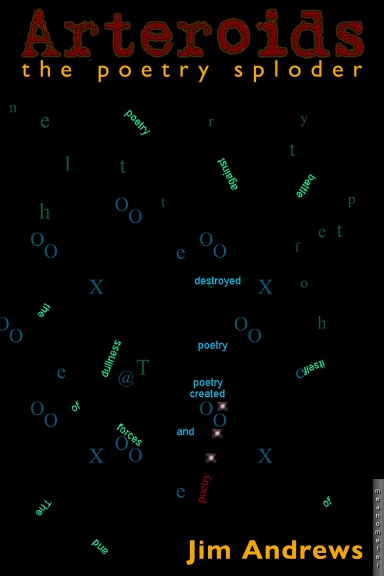
The battle of poetry against
itself and the forces of
dullness.
Turn out the lights!
Turn up the sound!
Throw away your
preconceptions
about poetry!
Loading...0%
Your ID

MAIN MENU
♫

HOW TO PLAY
- Use WASD or arrow keys to pilot poetry.
- Press the spacebar to dispatch missives (missives, not missiles.)
- Press the 'p' key to pause/unpause the game.
- Press the 'm' key to mute/unmute the sound.
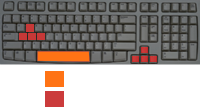
- I'm still working on the touch controls. The game won't be playable on phones (not enough space), but play mode will be OK on phones as a way to explore the poetry, audio, interactivity and interface. I hope to get it to the point where the game is playable on tablets. Currently, you can use Arteroids on mobile devices, but playing a game is very challenging. Stick to play mode on mobile, for now.
- Use left finger on left side of the screen to steer poetry.
- Tap the right side of the screen to dispatch missives.
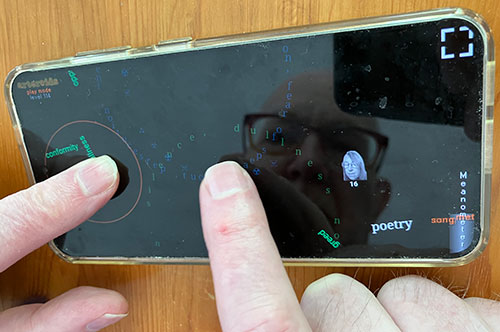
- I'm still working on the touch controls. The game won't be playable on phones (not enough space), but play mode will be OK on phones as a way to explore the poetry, audio, interactivity and interface. I hope to get it to the point where the game is playable on tablets, which have more screen space. Currently, you can use Arteroids on mobile devices, but playing a game is very challenging. Stick to play mode on mobile, for now.
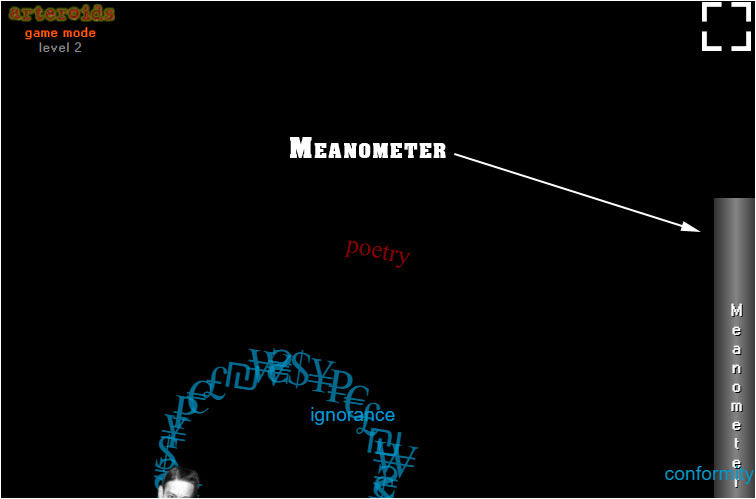
 he goal of the game is to max out the meanometer. As you
shoot/dispatch arteroids and boss monster poets, the
meanometer gets higher. When it reaches the full height
of the window, you win and the game is over.
he goal of the game is to max out the meanometer. As you
shoot/dispatch arteroids and boss monster poets, the
meanometer gets higher. When it reaches the full height
of the window, you win and the game is over.At level 1, you have to kill 10 arteroids to max out the meanometer. At level 216, the highest level, you have to kill 60 arteroids.
 Boss monster poets appear occasionally. They appear more
frequently as you ascend the levels. They get meaner. They
shoot more often, more accurately, and they're faster.
At level 1, it takes several shot to kill them. At level
216, it takes many more. They shoot missives, not missiles.
Boss monster poets appear occasionally. They appear more
frequently as you ascend the levels. They get meaner. They
shoot more often, more accurately, and they're faster.
At level 1, it takes several shot to kill them. At level
216, it takes many more. They shoot missives, not missiles. The boss monster poets are entertaining and deadly. They perform
their poetry while trying to kill you with missives.
They shoot at you, hunt you, hide from you,
sometimes circle the center of the screen, and sometimes meander.
The boss monster poets are entertaining and deadly. They perform
their poetry while trying to kill you with missives.
They shoot at you, hunt you, hide from you,
sometimes circle the center of the screen, and sometimes meander. So far, Adeena Karasick, Chris Joseph, Pauline Masurel, Clifton Joseph,
Jan-Christian Petersen, Charles Bernstein, T. S. Eliot and Jim Andrews
have appeared as boss monster poets. The plan is to do several more including
Kedrick James, Gregory Whitehead, Gregory Ulmer and Nikita Carter. The
T. S. Eliot boss monster poet is the strangest introduction to his poetry
you will ever encounter.
So far, Adeena Karasick, Chris Joseph, Pauline Masurel, Clifton Joseph,
Jan-Christian Petersen, Charles Bernstein, T. S. Eliot and Jim Andrews
have appeared as boss monster poets. The plan is to do several more including
Kedrick James, Gregory Whitehead, Gregory Ulmer and Nikita Carter. The
T. S. Eliot boss monster poet is the strangest introduction to his poetry
you will ever encounter. The number below a boss indicates its health. The higher the number,
the more shots it will take to kill it. However many missives it takes to
polish off a boss monster, that's how many regular kills
you're credited with when you finally kill it.
The number below a boss indicates its health. The higher the number,
the more shots it will take to kill it. However many missives it takes to
polish off a boss monster, that's how many regular kills
you're credited with when you finally kill it. Each boss is a special experience of poetry by an amazing poet.
 n game mode (main menu > game mode > play), if an arteroid (green or blue text) or boss
monster poet touches you, you're dead. If a boss hits you
with one of its missives, you're dead. You can only
play the levels you've already finished or the next one you haven't
finished. If your overall score
is one of the top global scores, it's saved
to the global leaderboard. The score for a given level is
based on your time, accuracy, and the number of kills.
n play mode (main menu > play mode > play), you can choose to be
mortal or immortal. When you're immortal, you can't be killed.
If you're mortal, you only die if the bosses and arteroids hit
you five times in a row before you hit them once.
When you're immortal, play mode is more like an interactive art
machine than a game. You can explore without worrying about
being killed.
n game mode (main menu > game mode > play), if an arteroid (green or blue text) or boss
monster poet touches you, you're dead. If a boss hits you
with one of its missives, you're dead. You can only
play the levels you've already finished or the next one you haven't
finished. If your overall score
is one of the top global scores, it's saved
to the global leaderboard. The score for a given level is
based on your time, accuracy, and the number of kills.
n play mode (main menu > play mode > play), you can choose to be
mortal or immortal. When you're immortal, you can't be killed.
If you're mortal, you only die if the bosses and arteroids hit
you five times in a row before you hit them once.
When you're immortal, play mode is more like an interactive art
machine than a game. You can explore without worrying about
being killed.In play mode, you can play any level you want.
The in-game play mode menu also lets you summon the boss monster poet of your choice. If you click the image of a poet in the in-game menu, that boss monster appears. Click it again to advance the audio.
The "random boss"/"loop boss" button on the play mode, in-game menu lets you specify whether the next boss will be randomly determined or whether the new boss will be the same as the old boss.
In play mode, your scores aren't saved to the leaderboard and they don't count toward your overall score.
n play mode, you can use the Arteroids editor, Word for Weirdos
(main menu > play mode > word for weirdos), to
write your own texts and then play them in play mode. These texts are
saved to your machine so you can reuse them or edit them later on. If you
want to move your texts to another machine, you can export them to a
memory stick or other device and then import them on the new machine.Importing your poems to another machine also means that when you play games, your scores will be saved to the leaderboard under the same name on both machines.
 enu Music is a new feature to the new version of Arteroids.
If you run the mouse (or your finger, on touch devices) over
the menu items of a menu top to bottom, and then bottom to top,
you'll hear a succession of 'notes', a musical phrase. Some of
them are from music you'll recognize. Some of them are original.
The sounds, on a given menu, are all the same, but the pitch is
shifted.
here is one leaderboard (main menu > game mode > scores) that all players of game mode share.
It records the global top 100 overall scores. An overall score is the
total of your scores at all the levels you've played. If you
haven't been invited to a private leaderboard, the top of the
'scores' screen looks something like this:
enu Music is a new feature to the new version of Arteroids.
If you run the mouse (or your finger, on touch devices) over
the menu items of a menu top to bottom, and then bottom to top,
you'll hear a succession of 'notes', a musical phrase. Some of
them are from music you'll recognize. Some of them are original.
The sounds, on a given menu, are all the same, but the pitch is
shifted.
here is one leaderboard (main menu > game mode > scores) that all players of game mode share.
It records the global top 100 overall scores. An overall score is the
total of your scores at all the levels you've played. If you
haven't been invited to a private leaderboard, the top of the
'scores' screen looks something like this: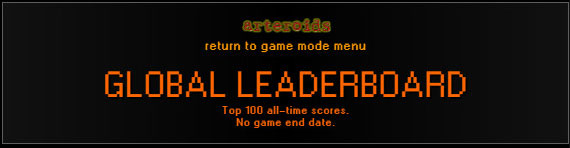
If you have been invited to a private leaderboard, the top of the 'scores' screen will look something like this:

HOW TO PLAY
GAME MODE
LEVEL 1
PLAY MODE
LEVEL 1
☰
Word for Weirdos
Play
New
Open
Delete
Save
Save As
Export / Import
Play Mode Menu
Click labels to style texts
Title
Author
+−
Arteroids1
Explosions1
+−
+−
Arteroids2
Explosions2
Missives (comma separated)
Id entity

Styling
Sample text
Color
Weight / Style
B
I
Font in use:
Arial
Available fonts
Add Font
Type name of a font installed on your machine. Then "Add Font".
OK
game mode
level 1
Meanometer
poetry
GLOBAL LEADERBOARD
This shows the top all-time scores.
This competition has no end date.
text
ABOUT
Arteroids 2026 is a shoot-em-up poetry game. It’s the battle of
poetry against itself and the forces of dullness. It’s the
attack of the boss monster poets. It’s language explosions,
language cracked open, poetry on the edge of other arts and
media. It’s a computer game like you’ve never played before.
It’s going to kill you many, many times. And you’re going to
love it. It's the world's first addictive poem, and it spells
trouble all day long.
There's play mode and game mode. In game mode,
it's 216 levels of sudden death and your scores get saved to the
leaderboard if they're good enough. In play mode, you can use
Word for Weirdos to create your own Arteroids text and save poetry
from yourself. In play mode, you can set the parameters the way you
want. You can play, without having to play the game. In game mode,
you play the hand you're dealt. Arteroids is a fun computer game
while being also an ambitious poetry project involving notable poets.
New features include:
- Boss monster poets
- Missives, not missiles
- Menu music
- Weirder Word for Weirdos
- Better explosions
- Free and paid app versions
The original version of Arteroids was created with Macromedia
Director in 2001. The new version is a complete re-write and
upgrade, and was written in JavaScript / HTML / CSS. Here are
writings about the initial version.
 Contains the texts that the old Director version can display after the player
completes a level or is killed. It also contains some of the texts that can
appear during game-play, and an essay by Andrews about Arteroids.
Contains the texts that the old Director version can display after the player
completes a level or is killed. It also contains some of the texts that can
appear during game-play, and an essay by Andrews about Arteroids.There is much more text in the Arteroids game than meets the eye. There are hundreds of texts that can appear after the player wins or loses a level. There's the array of texts for winners and the array of texts for losers. These texts explore the themes of Arteroids in a variety of ways, and are an important part of the game. The book gives you a chance to read these texts at your leisure, without arteroids at your throat. Check out this video about the book.
The web site of the old Director version of Arteroids.
"‘Poetry games’ are a hybrid form characterized as intrinsically paradoxical
by Astrid Ensslin in her 2014 book Literary Gaming. Digital poet Jim Andrews
likewise asserts that poetry and videogames go together like “oil and water.”
In this article, I argue that by examining in more detail the phenomenological
tensions between the two, we can better understand the ways in which poem-game
hybrids are able to negotiate this apparent incompatibility."
Essay about how art games typically subordinate game to art or art
to game.
“The basic thing about games is that events in a (usually imaginary) structure/world are generated via some mechanism (throwing dice, for example, or moving)....Each event introduces a change to the game world that the player responds to. What I would like to do in this meditation is consider several net-based works of digital art which use games as and within literary devices.
The artists creating these art pieces were more intent upon creating works of art than computer games. The works we’ll look at subordinate the videogame dimension to the literary or visual art dimension, to different extents. The videogame is used as and within literary devices whereas, in typical videogames, the game is not subordinated to anything. Like Heraclitus, the artists are most interested in seeing game and play in relation to the world. For instance, immersion would be in the literary dimension, typically, not the videogame dimension, or would be more in the literary than the videogame.”
“The basic thing about games is that events in a (usually imaginary) structure/world are generated via some mechanism (throwing dice, for example, or moving)....Each event introduces a change to the game world that the player responds to. What I would like to do in this meditation is consider several net-based works of digital art which use games as and within literary devices.
The artists creating these art pieces were more intent upon creating works of art than computer games. The works we’ll look at subordinate the videogame dimension to the literary or visual art dimension, to different extents. The videogame is used as and within literary devices whereas, in typical videogames, the game is not subordinated to anything. Like Heraclitus, the artists are most interested in seeing game and play in relation to the world. For instance, immersion would be in the literary dimension, typically, not the videogame dimension, or would be more in the literary than the videogame.”
“Arteroids is about driving and cracking language
and poetry open....Writing is now a larger thing.”
“In Game Mode, the player captains their beleagered
"poetry" ship as red red id entity text against the
green text, which is the forces of dullness incarnate,
and the blue text, which spells out a different message.
The blue and the green texts of imaginative destruction
explode, are cracked open like words vaporized into ideas,
when the player shoots them. Their explosions are circular
lettristic sprays of letters,
Arteroids is about cracking language open. William S. Burroughs said about audio tape that when you cut it, the future spills out. When writers and artists use cut-up techniques of all kinds on all types of media, when sound is an inscribable, editable object just as language is—and the same goes for video and other digitizable material information—then language is indeed cracked open in the sense that the fundamental symbols of writing are no longer simply the letters in the alphabet and other typographical marks. Writing is now a larger thing.”
Arteroids is about cracking language open. William S. Burroughs said about audio tape that when you cut it, the future spills out. When writers and artists use cut-up techniques of all kinds on all types of media, when sound is an inscribable, editable object just as language is—and the same goes for video and other digitizable material information—then language is indeed cracked open in the sense that the fundamental symbols of writing are no longer simply the letters in the alphabet and other typographical marks. Writing is now a larger thing.”
ABOUT
CREDITS+
Jim Andrews
wrote the original version of Arteroids in Macromedia
Director in 2001. He also wrote Arteroids 2026, a big rewrite
and featureful upgrade of the original version, in JavaScript / HTML5 / CSS.
Andrews is a poet-programmer and media artist. Andrews has been
publishing his site vispo.com since 1996. He lives in Vancouver.
The sounds the boss monster poets make are all from the boss monster
poets themselves. The rest of the sounds, such as the menu music and
the sounds the arteroids make when they die, are vocal sounds by Andrews,
often pitch shifted.
The (hundreds of) texts in the game that the player reads when they win
or lose a level, and the texts that appear during game-play, were written
by Andrews. The set of missive texts that each boss fires off was written
by the boss monster poets themselves.
Arteroids 2026 is the first work in which Andrews used an AI assistant:
Claude Code Sonnet 4.6 via Copilot for VSCode. It saved Andrews vast amounts of time.
That free time was used to create new features like the boss monster
poets, menu music, weirder Word for Weirdos, and better explosions.
 Slava Bart
has been published internationally in Canada, Russia, and Israel.
His arteroidel, "sparrows in the gut", fuses the languages of the
boss monster poets with elements of the Lurianic Kabbalah and Monty Python.
Slava Bart
has been published internationally in Canada, Russia, and Israel.
His arteroidel, "sparrows in the gut", fuses the languages of the
boss monster poets with elements of the Lurianic Kabbalah and Monty Python.
 Charles Bernstein
is an American poet, essayist, editor, and literary scholar. Closely associated
with L=A=N=G=U=A=G=E, his boss monster poet uses material from the PennSound videos
"The Task of Poetics" at the U. of Chicago (2006),
"Charles Bernstein at UCD" (2019), and
"Attack of the Difficult Poems" (2012).
Charles Bernstein
is an American poet, essayist, editor, and literary scholar. Closely associated
with L=A=N=G=U=A=G=E, his boss monster poet uses material from the PennSound videos
"The Task of Poetics" at the U. of Chicago (2006),
"Charles Bernstein at UCD" (2019), and
"Attack of the Difficult Poems" (2012).
 T. S. Eliot
(1888-1965) was an American-English poet, essayist, publisher, playwright, and literary critic.
One of the 20th century's major poets. His boss monster poet uses
material from "The Love Song of J. Alfred Prufrock," "The Waste Land," "The Hollow
Men," "Four Quartets" and "Preludes".
T. S. Eliot
(1888-1965) was an American-English poet, essayist, publisher, playwright, and literary critic.
One of the 20th century's major poets. His boss monster poet uses
material from "The Love Song of J. Alfred Prufrock," "The Waste Land," "The Hollow
Men," "Four Quartets" and "Preludes".
 Isidore Isou
(1925-2007) was a Romanian-born French poet, film director and artist. He founded Lettrisme in 1945, which influenced
the Situationists and art in general. Lettrisme also influenced visual and digital poetry. Lettrisme
is involved not only with writing but with visual art, film, audio/music, and other media and arts. That is part of
its appeal and influence. Also, its focus on the letter, rather than the word, opens it more easily
to the visual and sonic realms. Isidore's boss monster poet uses material from the Roland Sabatier
project
Isidore
Isou: Poemes Lettristes 1944-1999.
Isidore Isou
(1925-2007) was a Romanian-born French poet, film director and artist. He founded Lettrisme in 1945, which influenced
the Situationists and art in general. Lettrisme also influenced visual and digital poetry. Lettrisme
is involved not only with writing but with visual art, film, audio/music, and other media and arts. That is part of
its appeal and influence. Also, its focus on the letter, rather than the word, opens it more easily
to the visual and sonic realms. Isidore's boss monster poet uses material from the Roland Sabatier
project
Isidore
Isou: Poemes Lettristes 1944-1999.
 Kedrick James
is a Canadian poet, musician, app developer, and scholar. He leads the Education Department
at UBC Okanagan in Kelowna, BC. His most recent book is Becoming Ecological (2026, U of
Toronto Press) with Derek Gladwin. His boss monster is made of music by The Emetics: Kedrick,
Don Klassen, and Ernesto Peña. Arteroids uses music from two 2021 Emetics albums:
Macular
Degenerates and
Subconscious Mines.
Chris Joseph
has created one of the great web sites in the world of multimedia literature:
chrisjoseph.org.
He is a poet, artist, programmer, musician, and audio guy. His boss monster poet
uses material created entirely for Arteroids. Originally from Canada, he lived in
London for decades and is now living in Berlin.
Kedrick James
is a Canadian poet, musician, app developer, and scholar. He leads the Education Department
at UBC Okanagan in Kelowna, BC. His most recent book is Becoming Ecological (2026, U of
Toronto Press) with Derek Gladwin. His boss monster is made of music by The Emetics: Kedrick,
Don Klassen, and Ernesto Peña. Arteroids uses music from two 2021 Emetics albums:
Macular
Degenerates and
Subconscious Mines.
Chris Joseph
has created one of the great web sites in the world of multimedia literature:
chrisjoseph.org.
He is a poet, artist, programmer, musician, and audio guy. His boss monster poet
uses material created entirely for Arteroids. Originally from Canada, he lived in
London for decades and is now living in Berlin.
 Clifton Joseph
is one of the founders of Canada's dub poetry movement.
Born in Antigua and raised in Canada, he's a poet,
educator, performer, and journalist. He wrote Metropolitan
Blues, a book of poems; several recordings of poetry & music
including his debut album Oral / Trans / Missions, and Shots
On Eglinton. His boss monster poet uses material created
for Arteroids plus recordings of him performing his
poetry at Gallery 881 in Vancouver in 2026. He lives in Toronto.
Adeena Karasick
grew up in Vancouver but has been living and teaching in
New York at Pratt for decades. She has published 16 books of
poetry with Talonbooks (Vancouver) and Lavender Ink (New Orleans).
Her boss monster poet in Arteroids uses material from her poems "Desiring
Machine" and "Checking In 3" forthcoming in her new book Sonic
Warfare from Roof Books, NY.
Clifton Joseph
is one of the founders of Canada's dub poetry movement.
Born in Antigua and raised in Canada, he's a poet,
educator, performer, and journalist. He wrote Metropolitan
Blues, a book of poems; several recordings of poetry & music
including his debut album Oral / Trans / Missions, and Shots
On Eglinton. His boss monster poet uses material created
for Arteroids plus recordings of him performing his
poetry at Gallery 881 in Vancouver in 2026. He lives in Toronto.
Adeena Karasick
grew up in Vancouver but has been living and teaching in
New York at Pratt for decades. She has published 16 books of
poetry with Talonbooks (Vancouver) and Lavender Ink (New Orleans).
Her boss monster poet in Arteroids uses material from her poems "Desiring
Machine" and "Checking In 3" forthcoming in her new book Sonic
Warfare from Roof Books, NY.
 Pauline Masurel
is a British writer of short and fractured forms. She also sometimes plays the cello. Her work has been published in print, online and performed live in many different spaces. Her boss monster poet uses material from the combinatory poem "Monsters".
Pauline Masurel
is a British writer of short and fractured forms. She also sometimes plays the cello. Her work has been published in print, online and performed live in many different spaces. Her boss monster poet uses material from the combinatory poem "Monsters".
 Jan-Christian Petersen
is a poet, writer, and cultural mediator from Germany. He publishes
journalistic articles in newspapers and (specialist) magazines, and
presents his narrations, poems, and text art at exhibitions and readings.
His boss monster poet in Arteroids uses recordings and text created
specially for the game.
Jan-Christian Petersen
is a poet, writer, and cultural mediator from Germany. He publishes
journalistic articles in newspapers and (specialist) magazines, and
presents his narrations, poems, and text art at exhibitions and readings.
His boss monster poet in Arteroids uses recordings and text created
specially for the game.
 Gregory L. Ulmer
is Professor Emeritus, English and Media Studies, University of Florida.
He is the author, with the Florida Research Ensemble (FRE), of Miami
Virtue: Choragraphy of the Virtual City. His current collaboration
with the FRE is Deep Genius: Education After AI. Ulmer’s
publications develop electracy as being for the digital apparatus what
literacy is for alphabetic writing.
Gregory L. Ulmer
is Professor Emeritus, English and Media Studies, University of Florida.
He is the author, with the Florida Research Ensemble (FRE), of Miami
Virtue: Choragraphy of the Virtual City. His current collaboration
with the FRE is Deep Genius: Education After AI. Ulmer’s
publications develop electracy as being for the digital apparatus what
literacy is for alphabetic writing.
 Gregory Whitehead
is an American radiomaker, audio artist, text-sound poet,
playwright and media philosopher based in Lenox,
Massachusetts. He has created radio artworks, plays, and
experimental features for the BBC, Radio France,
Deutschland Radio, Australia's ABC, NPR and other
broadcasters.
Gregory Whitehead
is an American radiomaker, audio artist, text-sound poet,
playwright and media philosopher based in Lenox,
Massachusetts. He has created radio artworks, plays, and
experimental features for the BBC, Radio France,
Deutschland Radio, Australia's ABC, NPR and other
broadcasters. His boss monster poet in Arteroids uses 8:46 of audio from Gregory's 2020 piece "As All the Heavens" (with Aimée Anders as the Voice of the No Place). "As All the Heavens" is based on four lines of an Emily Dickinson poem "I felt a Funeral in my Brain".
Gregory's boss uses woundSounds from his audio works "Dead Letters", "Escalated Ziggurat Inhalation", and "If a Voice Like, Then What?". The deathSounds are from his amazing piece "The Pleasure of Ruins".
CREDITS
ABOUT THE ARTEROIDELS
sparrows in the gut,
uses elements of what's known
as the Lurianic Kabbalah, a mid-16th century tradition.The central myth of this tradition is that God had to undergo a self-withdrawal (tzimtzum) to make room for the world. Then he filled vessels with divine light as part of creation. But the light was too intense and they shattered (why God couldn’t get stronger vessels from Walmart, nobody knows). This shattering became a key element of creation itself: the world is made of shards (qlipot) and even the simplest or basest things contain sparks (nitzotzot) of the divine. The purpose of human beings is to practice a form of attention and intentionality (kavannah) which observes divine light and words – literally – within each object, no matter how base, and helps repair what is broken.
This premise is infused with playful responses to the boss-poet’s words, Eliot's Hollow Men, Bernstein's essay on poetics, Isou’s lettrist cries and whimpers. In a sense this is a clash of creations: poets skirmish with Yahweh in a word-slinging duel as a way of asking the question: Is God the ultimate word-wielder or is He but a word Himself which can be shattered?
In my poem, God undergoes the tzimtzum, the self-withdrawal, by biting His tongue. This is a reference to a personal story of abandoning my mother tongue, Russian, as a means of creation, a personal withdrawal followed by alternative creation out of the shards of different languages: English, French, Russian, Hebrew, Kazakh, Japanese...
TBD
ABOUT THE ARTEROIDELS
ABOUT
The app version of Arteroids will be the only version
that includes Play Mode. Play Mode includes Word for
Weirdos, where you can write and play your own texts
plus those of others, and Boss Arteroids Hurling
Shakesperian insults. The app will also include more
menu music.
This message has many more words than you might expect iuyg iuyg iuyg iuyg iyg iuyg iuyg iuyg iuyg iyug iyg iyug
OK
Open
MY POEMS
GUEST POEMS
No saved poems.
Open
Cancel
Message
Yes
No
Save As
Save
Cancel
Export / Import
Export
Export your poems or all your Arteroids info to the clipboard.
Import
Import poems or all Arteroids info.
Cancel
This is a sample text to see what is going on.